


Make the Big Strategic Decision With Confidence
Decision Analysis for owners of small and midsize businesses facing an expansion, an acquisition, a major investment, or any decision too big to make alone.
Your advisor suggested Decision Analysis. Here's what that means.
If you're reading this, someone you trust thinks a decision in front of you deserves more than a gut call or a single spreadsheet. Maybe it's your consultant. Maybe it's your corporate finance advisor.
Decision Analysis (DA) is a structured way to make a big business decision that's hard to reverse. First, we help you and your leadership team agree on three things: what you're really deciding, what success looks like, and how you'll judge the options. That happens before anyone commits money. Then we compare the real alternatives fairly. When the numbers matter, we show you the full range of what each option could be worth. We run the process, so your team can focus on the decision.
DA doesn't replace the professionals you'll need to carry out the decision. It gives you, your team, and your advisor a clear, shared answer to one question: "Where do we want to go, and why?"
Our clients value peace of mind. They know getting a decision right now costs far less than unwinding the wrong one later. They aren't looking to dip a toe in. They have a decision that will change the business, and they're ready to act. Sometimes a deadline is forcing it. Sometimes waiting has become a decision of its own. Either way, they want a clear view of what's next.

What Decision Analysis Does for an Operating Company
Decision Analysis was built for running companies. The largest companies in the world have used it for decades on their biggest calls: to make sharper capital decisions, choose faster between projects, and cut downside risk.
For our clients, that usually means a live decision that will change what the company becomes. For example:
Growth. Expanding into a new market, acquiring a company or a competitor, or entering a joint venture or strategic partnership.
Footprint and capacity. Opening a new location, plant, or facility, consolidating the ones you have, or changing how much you can produce.
Major capital. A large investment in equipment, technology, or capacity, a make-versus-buy choice, or a contract that would bind the firm.
Market and offer. Entering or leaving a market, a pricing or business-model change (for example, moving to service contracts or subscriptions, or dropping a product line), or a pivot that reshapes what you sell.
Organization. Reorganizing or restructuring the company, when it's a real choice between paths.
A defining choice. Selecting a major vendor or a new system that would change how the company operates (a real fork, not a routine renewal), or deciding who the organization wants to become and which path gets you there.
This is for a decision with real alternatives, not an annual retreat, a routine renewal, or a study to dress up an answer that's already been chosen. If you're not sure your decision qualifies, the free conversation is where we figure that out.
Why Big Strategic Decisions Are More Daunting for a Small or Midsize Company
Your dollar figures may be smaller than a mega-cap's, but the stakes are often higher, because for a closely held or family-owned company the decision is systemic. One expansion, one acquisition, or one plant can reshape the whole business.
Here's what usually makes these decisions hard:
Competing objectives. Growth, risk, cash, control, and your own time all pull in different directions. You can't maximize all of them at once.
Real uncertainty. Demand, costs, financing, and timing are all unknowns, and they don't move independently.
Several people with a stake. Owners, partners, key managers, lenders, and advisors each see the decision differently.
Momentum. Once an idea has a champion, a deadline, or a seller on the other side of the table, it gets harder to ask whether it's the right move at all.
Waiting has a cost. Sometimes a deadline is forcing the issue. Sometimes the harder fact is that not deciding has become a decision of its own.
What happens when the framing step is skipped
Most teams jump to the answer they already like, then build the numbers to support it. Better alternatives never get a fair look, disagreements stay unresolved, and the risks show up after the money is spent. That isn't a lack of intelligence or effort. It's what happens to any organization, large or small, without a structured process. Most decision makers skip this step and pay for it later.
How Decision Analysis Works
Decision Analysis is the science of decision making, drawing on behavioral science, game theory, and statistics. Our Managing Director, Thomas DeVries, spent about 15 years applying it to really big, capital-intensive, strategic decisions with companies such as Chevron, Oxy, Anadarko, and Bechtel. Triane scaled those same tools for small and midsize businesses, so you get the discipline without the overhead a large corporation carries. In the room, we are practitioners: we set the agenda, facilitate the conversation, and keep the work pointed at a real decision. But the thoughts are yours. We help organize what you already know, fill in the blanks, and give a clear view to you, the people in the room, and the people you'll bring in to carry it out.
DA has two sides. The decision side, part of every engagement, gets your team clear and aligned on your best options. The numbers side, stochastic modeling, shows what each of those options could really be worth. Some decisions need only the first. Large capital decisions usually benefit from both.
The decision side: four steps
1. Frame the real decision.
We go deeper than the opportunity in front of you. What problem are we actually solving? What is the organization willing to become? What's already decided, what must be decided now, and what can wait? What do success and failure look like for the company and its owners?
2. Put everything on the table.
Objectives, constraints, assumptions, and uncertainties, from everyone with a stake. When it's all visible, the team can align on substance instead of guesswork.
3. Agree on the criteria, then evaluate the alternatives fairly.
Before anyone falls in love with an idea, we agree on how the options will be judged. Then your team generates the real alternatives, typically three to five, including ones nobody had raised yet, and we score each one against those criteria. The best ideas tend to come from your own people; our job is to draw them out and test them.
4. Commit with a clear path forward.
You leave knowing what you're choosing, why, what you're trading off, and what has to go right.
Seeing the Range: Stochastic Modeling for Large Capital Decisions
Every pro forma has one thing in common: the bottom-line number will never be the actual number. Behind it sit dozens of assumptions about prices, costs, volumes, timing, and financing, and most people can't tell how much each one moves the result.
Stochastic modeling makes that visible. It's the same approach large energy and engineering companies, including Chevron, Oxy, Anadarko, and Bechtel, use to evaluate major capital (CapEx) projects before they commit. We start from the leading options the sessions produced, usually three to five scenarios. With the people who know your business, we put a realistic range on each key input. Then we run the model through thousands of trials (Monte Carlo simulation). Instead of one number per option, you see the range of outcomes that are reasonably possible and how likely each one is.
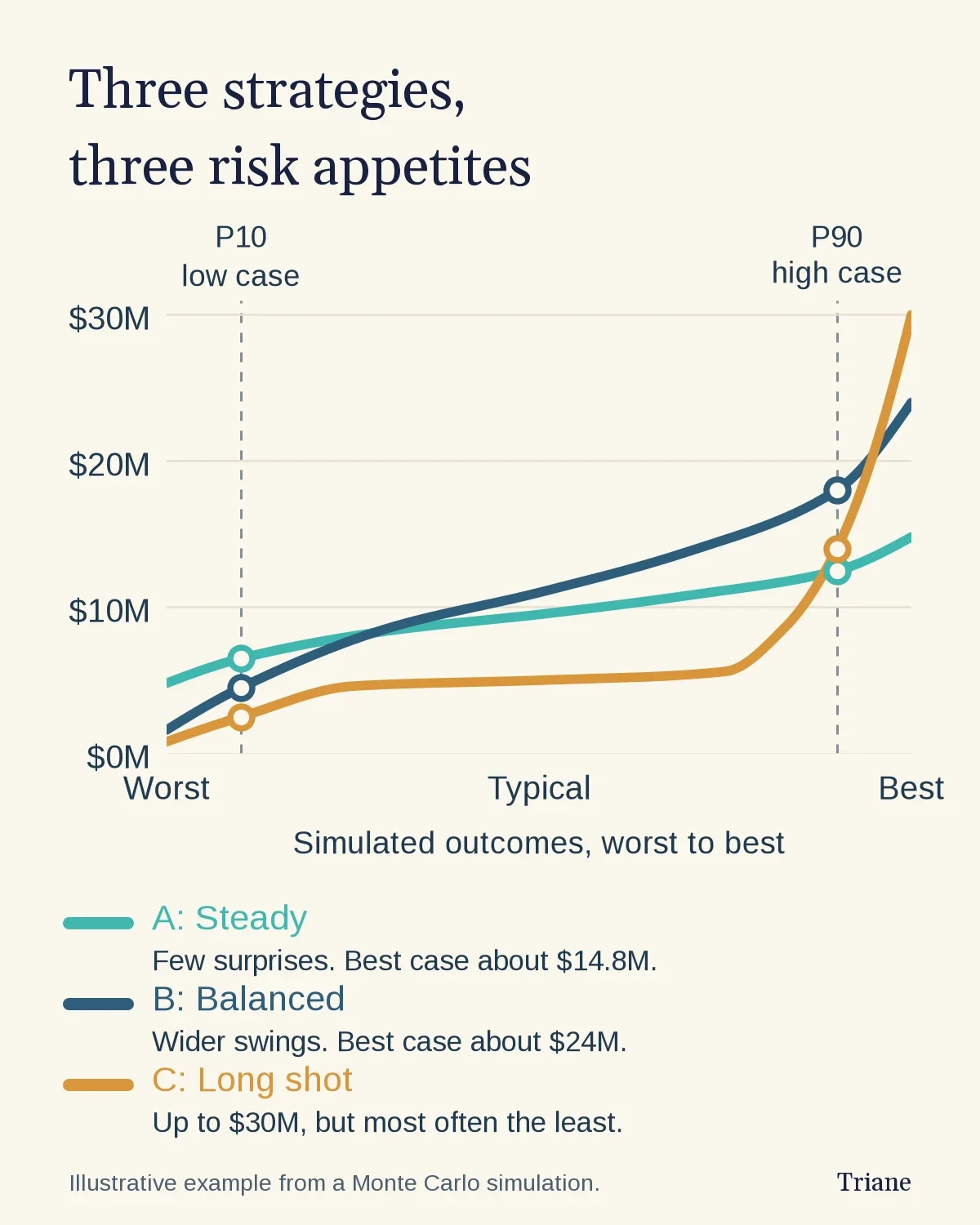
Reading the chart (illustrative example)
Each line is one strategy. We run each one through thousands of simulated outcomes, then line those outcomes up from worst on the left to best on the right. The higher the line, the more the business makes. Two markers matter most:
P10 is a realistic downside: only 1 in 10 outcomes comes in lower.
P90 is a realistic upside: only 1 in 10 outcomes comes in higher.
A note for readers from oil and gas: on this chart, P10 is the low case and P90 is the high case, the reverse of the reserves-reporting convention.
Here's what this example shows. Each line is a different risk appetite:
A: Steady. A realistic downside of about $6.5 million, a realistic upside of about $12.5 million, and a best case near $15 million. The narrowest range and the fewest surprises, with the lowest ceiling.
B: Balanced. About $4.5 million on the downside and about $18 million on the upside, with a best case near $24 million. Through most of the range it beats A, but in a bad case it can land below A's floor.
C: Long shot. The biggest possible payout of the three, about $30 million in the best cases. But it also has the lowest floor, about $2.5 million, and through the middle half of its outcomes it sits around $5 million, the least of the three. Most of the time, C makes the least money. Once in a while, it makes the most.
Why it matters
None of these is the "right" answer. Each one fits a different appetite for risk. An owner who needs dependable cash flow, or can't absorb a bad outcome, might choose A. One who wants the best typical result and can handle some swings might choose B. One with deep reserves who is chasing a big win, and can live with C's most likely result, might choose C.
Here's the catch: you can't see any of this without the model. A standard pro forma gives each strategy one bottom-line number, and a single number can't tell you that C usually makes the least money but occasionally makes the most. Only stochastic (Monte Carlo) modeling shows the full spread of outcomes for each strategy, how likely each one is, and how much you could make or lose. With that in front of everyone, each decision maker can choose based on their own risk appetite, and explain why.
The results also show which few inputs drive most of the swing, so you know where to dig deeper, or reduce risk, before you commit, and where you don't need to. Because those results rest on stated assumptions, you can come back to them as conditions change. The report gives you the financial backbone for your final go or no-go decision, and for the conversation with your partners, board, or lender.
In addition to the sessions, not more of them
Modeling is added to the sessions, not more of them. The model build takes two to four weeks after facilitation, and the review with your team is part of it.
It isn't needed for every decision, but for a large capital decision it's often where the clearest answers come from.
What You Leave With
At the end of the engagement, we build a Decision Support Package: a transparent map of how your team reached its decision. It includes:
A framed decision and a strategic hierarchy. What you're deciding now, what's already decided, and what can wait.
Agreed criteria and a fair comparison. The real alternatives, typically three to five, how each one scored, and why.
A clear view of risk and uncertainty. What could go right or wrong and, if modeled, a report on the range of outcomes for each of those scenarios and the inputs that drive them.
A path forward. What has to be true for the chosen option to succeed, the signposts to watch, and what to ask of your team and your advisors next.
You'll be able to show your partners, board, lender, or family how your thinking led to this decision. And you'll have peace of mind.
Is Decision Analysis Worth It for a Company Our Size?
Usually, yes, when the decision is big, hard to reverse, and uncertain. The cost of structuring the decision is small next to the cost of a wrong commitment on an acquisition, a plant, or a major investment. Our clients would rather spend a little more on the thinking now than a lot more undoing a decision later.
We keep it right-sized. Triane streamlined the process for small and midsize companies, so it takes a focused amount of your leadership team's time, not months of it. And if one conversation gives you all the direction you need, we'll tell you so.
How a Decision Analysis Engagement Works
It starts with a free conversation. It costs nothing, and you're not signing up for anything. Usually a phone call to get the lay of the land, and your advisor is welcome to join.
The sessions typically take two to four weeks. Decision Analysis usually runs as three to four facilitated sessions, or as a two-day offsite. Each session is a half-day. Sessions can be held at your office or offsite. Your key decision makers, and the leaders most affected by the decision, are in the room and engaged. Workshops work best in person, and we're glad to travel to you. Your trusted advisor is welcome too.
If the decision calls for modeling, that work follows the sessions. The model build takes another two to four weeks, in addition to the facilitation, and adds no extra workshops. We model three to five scenarios, based on what the sessions produced. After the first draft, we meet with the team to make tweaks and adjustments, then run the model a final time and deliver the report.
The materials are built to be shared. The Decision Support Package, and the modeling report when there is one, are designed to be shown to your owners, board, lenders, and advisors, and we stay available for follow-up.
Who This Is For
This is usually a good fit for:
Owners, family principals, CEOs, and boards of small and midsize businesses, especially closely held and family-owned companies, facing a decision that will change what the company becomes. A professional CEO or a board can be a fit when they have the authority to commit and will sit in the sessions.
Leadership teams that will put the decision maker and the leaders most affected in the room. The work only succeeds if the people who will live with the outcome are present and engaged.
Situations with competing priorities, several stakeholders, or real uncertainty, where a single spreadsheet or a single opinion isn't enough.
Many of our clients are introduced by a trusted advisor, such as a management consultant, a corporate finance or M&A advisor, a CPA, or an attorney. We work alongside them: we help you decide where to go, and they help you get there. Your advisor is welcome in the room. We facilitate the decision work; they remain the experts in their own domains.
Triane is based in Houston and works with owners anywhere in the United States.
If the decision is about selling or passing on the business, see Founder Exit Planning.
Strategic Decisions: Frequently Asked Questions
-
Decision Analysis is a structured process for making big, hard-to-reverse decisions. It helps an owner and leadership team frame the real decision, agree on how options will be judged, compare the alternatives fairly, and account for risk and uncertainty. For a small or midsize business, it brings the discipline large corporations use on major projects, right-sized so the decision is clear, explainable, and defensible.
-
We complement your advisor; we don't replace them. Consultants and corporate finance advisors are often best at assessing where you are and executing how you get there. Triane focuses on where you want to go and why. Your advisor is welcome in the free conversation and in the workshops, and the Decision Support Package gives them a clear brief to work from.
-
Decision Analysis fits a live decision that will change what the company becomes: one that is large, hard to reverse, uncertain, and affects the whole company. Common examples include an expansion, acquiring a company or competitor, a joint venture or strategic partnership, a new location or plant, a major capital investment, a make-versus-buy or binding-contract choice, entering or leaving a market, a pricing or business-model change, reorganizing or restructuring the company when it's a real choice between paths, or selecting a major vendor or system that would change how the company operates. It is not a fit for an annual retreat, a routine renewal, or a study to dress up an answer that's already been chosen.
-
Stochastic (Monte Carlo) modeling runs a financial model of each option through thousands of trials, so you see the range of likely outcomes instead of one bottom-line number. That shows each strategy's risk profile: one may offer the biggest possible payout but the greatest chance of making the least money, and without the model you can't tell which is which. It's the same approach large energy and engineering companies use to evaluate major capital projects. It's an optional addition to the Decision Analysis sessions. The sessions typically take two to four weeks; the model build takes another two to four weeks and doesn't require extra workshops. We model three to five scenarios based on what the sessions produced, meet with the team after the first draft to make tweaks and adjustments, then run the model a final time and deliver the report.
-
A business plan or financial model usually describes one option in detail, with one bottom-line number. Decision Analysis decides which option deserves that detail. It frames the decision, sets the criteria first, compares several real alternatives fairly, and can show the range of possible outcomes for each. It's the same discipline used by companies such as Chevron, Oxy, Anadarko, and Bechtel for their major decisions, only right-sized for small and midsize enterprises.
-
When the decision is big, hard to reverse, and uncertain, usually yes. The cost of structuring the decision is small compared with the cost of a wrong commitment. Engagements are right-sized, typically three to four half-day sessions or a two-day offsite over two to four weeks. Sessions can be held at your office or offsite, and the first conversation is free. If that conversation gives you all the direction you need, we'll tell you so.
-
Facilitation typically takes two to four weeks, as three to four half-day sessions, held at your office or offsite, or as a two-day offsite. If we add stochastic modeling, the model build takes another two to four weeks, and adds no extra workshops. You get a Decision Support Package: the framed decision, the criteria you agreed on, how each alternative scored, a clear view of risk and uncertainty, and a path forward you can share with your owners, board, lenders, and advisors. When the work includes modeling, you also get a report on three to five scenarios, based on what the sessions produced, including the range of outcomes for each.
Know Where You Want to Go. Then Commit.
If you own or lead a small or midsize business and a big strategic decision is on the table, you don't need to have it all figured out before you call. That's the point of the call. And the first conversation is free.
Send a quick email or give us a call, and let's start a conversation about what's next for your business.
Led by Thomas DeVries, whose Decision Analysis experience includes work with Chevron, Oxy, Anadarko and Bechtel.
832-536-4170